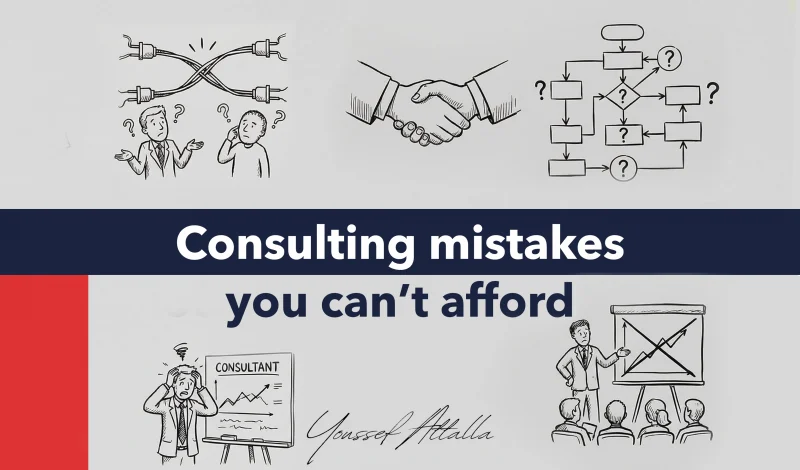

Consulting doesn’t fail because of bad intentions, it fails because of small, overlooked consulting mistakes that quietly drain value, delay execution and surprisingly destroy ROI.
In 2026, businesses are spending more than ever on management consulting and consulting services. Yet many still ask the same question: ” Why didn’t this engagement deliver the impact we expected?” The answer is rarely the consultant alone. It’s usually a flawed decision around consulting strategy, poor engagement design or weak execution.
As consulting becomes a core driver of transformation, treating it casually is no longer an option.
Companies that succeed use consulting as a strategic tool, with clear governance, strong alignment to long-term business strategy, and a sharp focus on consulting ROI. Those that don’t repeat the same mistakes and pay for them twice.
So now, below are the top consulting mistakes companies make in 2026, the real consulting challenges behind them and how to exactly avoid them to maximize performance and results.
1. Treating Consulting as a Short-Term Fix Instead of a Strategic Tool
The mistake
One of the most common mistakes companies make is hiring consultants reactively only when a problem becomes urgent. This limits consulting to firefighting rather than using consulting as a strategic tool aligned with long-term goals
How to Avoid It
- Position consulting within your long-term business strategy
- Build a clear consulting roadmap tied to business priorities
- Use consulting engagements to support transformation, not just problem-solving
When consulting supports strategy, performance and ROI improve significantly.
2. Poor Strategic Alignment of Consulting Engagements
The Mistake
Many consulting challenges start with misalignment. Companies engage consultants without clearly defining how the project supports core strategy, leading to low-impact outcomes.
This is a classic consulting engagement failure that drains budgets without delivering results.
How to Avoid It
- Define strategic objectives before hiring consultants
- Link each consulting project to measurable business outcomes
- Ensure leadership alignment throughout the engagement
Strong alignment is the foundation of high-performing consulting projects.
3. Hiring Consultants Without a Clear Value or ROI Model
The Mistake
Another major mistake when hiring consultants is failing to define success metrics. Without clear KPIs, companies struggle to evaluate consulting performance or justify spend.
This directly impacts ROI campaigns and decision-making.
How to Avoid It
- Set outcome-based KPIs from day one
- Track impact throughout the engagement
- Focus on value creation, not just deliverables
4. Confusion Between In House-Teams and Consultants
The Mistake
Blurring the line between in-house team vs consultants is one of the most overlooked consulting mistakes. Consultants are often used for tasks that internal teams could handle, reducing efficiency and knowledge transfer.
How to Avoid It
- Clearly define roles and responsibilities
- Use consultants for high-impact, specialized work
- Strengthen internal capabilities alongside external support
The right balance improves both internal performance and consulting outcomes.
5. Weak Consulting Procurement and Vendor Selection
The Mistake
Poor consulting procurement of consulting services processes lead to selecting the wrong partners based on brand or price rather than strategic fit. This mistake limits value and increases delivery risk.
How to Avoid It
- Evaluate consultants based on expertise and relevance
- Standardize selection criteria
- Align procurement with strategic priorities, not just cost control
Just remember that effective procurement is essential for successful consulting services.
6. Over-Managing or Under-Managing Consultants
The Mistake
You may not consider this as a critical mistake but ineffective consulting management is a silent performance killer. Some organizations micromanage consultants, while others provide no governance at all, both reduce impact.
How to Avoid It
- Assign a clear internal project owner
- Establish governance and decision rights
- Maintain regular performance reviews
Strong management ensures accountability and better results.
7. Failing to Turn Consulting Insights Into Action
The Mistake
Last one but one of the most damaging consulting mistakes is stopping at recommendations. Without execution, even the best consulting strategy delivers zero value.
How to Avoid It
- Build implementation plans into every engagement
- Link insights to operational execution
- Track post-project impact on business performance
Consulting creates value only when insights are executed.
You have to keep in mind that in 2026, consulting mistakes don’t just slow companies down, they hold them back. As consulting becomes embedded in everyday business decisions, success now depends on structure, clarity and strategic intent.
Companies that focus on alignment, execution and measurable outcomes don’t struggle with consulting challenges, they maximize consulting ROI. The rest keep paying for advice that never turns into action. When used correctly, consulting isn’t a cost center, it’s one of the most powerful growth levers a business can pull.
Avoiding consulting mistakes is only the first step. Turning consulting into a real growth driver requires the right strategy, execution, and guidance.
If you want to build a consulting approach that delivers measurable results not just recommendations, Youssef Attalla Business Consultant, helps companies design smarter strategies, optimize consulting engagements, and maximize ROI.
Book a strategy call with Youssef Attalla and turn consulting into a competitive advantage.